
Astrotheology
An examination of early astrotheological concepts among the Babylonians and Egyptians.

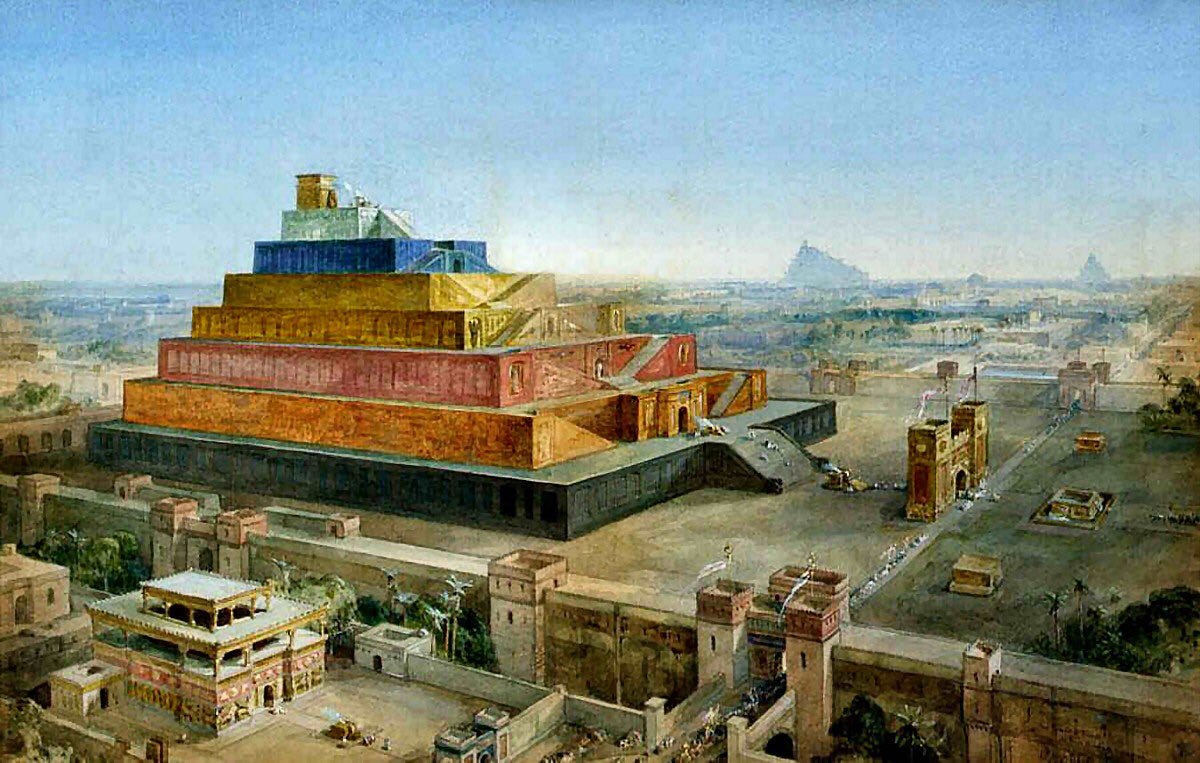
“On the topmost tower there is a spacious temple, and inside the temple stands a couch of unusual size, richly adorned, with a golden table by its side. There is no statue of any kind set up in the place, nor is the chamber occupied of nights by any one but a single native woman, who, as the Chaldaeans, the priests of this god, affirm, is chosen for himself by the deity out of all the women of the land. They also declare - but I for my part do not credit it - that the god comes down in person into this chamber, and sleeps upon the couch. This is like the story told by the Egyptians of what takes place in their city of Thebes, where a woman always passes the night in the temple of the Theban Jupiter [Amen-Ra].” - Herodotus, 1History of the Persian Wars (430 BCE)
Astrotheology can be explained as an attempt to identify the relationship between spiritual reality and the stars, planets, and celestial energies. It is both the realization of the work of God in the cosmos and the recognition of our place inside of it as a reflective unit of a whole, which maintains, on account of its own existence, the divine patterns of nature. In this article, we will explore how some early civilizations encoded some of these patterns into their gods and architecture.
The study of astrotheology asks, “What influence do the orbs of the night sky have on myths and religious beliefs?” and takes for granted the idea that most religious texts contain both allegorical and objective allusions to celestial objects, often in direct relationship to the function of their deities.
Take one of the Hymns to the sun god, Surya, in a sacred Hindu text -
HIS bright rays bear him up aloft, the God who knoweth all that lives,
Surya, that all may look on him. The constellations pass away, like thieves, together with their beams, Before the all-beholding Sun' His herald rays are seen afar refulgent o'er the world of men, Like flames of fire that burn and blaze. Swift and all beautiful art thou, O Surya, maker of the light, Illuming all the radiant realm. Thou goest to the hosts of Gods, thou comest hither to mankind, Hither all light to be belield. With that same eye of thine wherewith thou lookest brilliant Varuna, Upon the busy race of men, Traversing sky and wide mid-air, thou metest with thy beams our days, Sun, seeing all things that have birth. - Rig Veda (Griffith translation)
It is not only in the earliest texts but in the earliest monuments that we find connections between the heavenly gods and the earthly beings that worship them. Above us all and unending in every direction is the incomprehensible space of which we occupy but an infinitesimal fraction. In the ancient world as today, the heavens displayed the mysterious presence of forces so beyond our capacity to fathom we had no choice but to recognize the work of divine power.
This presence must be intelligent on account of the intelligence that has come from it, and the intelligence required to define it. It is wise on account of the wisdom it must have taken to create it. It is good because the good that we can aspire to resembles a state of being that nature has conspired to make beautiful.
Thus if there is any repeatable sign in the heavens and we can account for a repeatable change in our environment or our psyche during such a sign, it would work in our benefit to understand the differences between the signs and the changes; to figure out what utility they have and ascribe a meaning to them which satisfies our curiosity.
Our most practical example of the sun’s mastery over our lives is the necessity for sleep. Light is wakefulness, and intelligence. Darkness is rest and unknown. As the giver of life, the sun’s position in the hierarchy of celestial objects is always at the pinnacle. It is the crown object, as it were, which is why its outer atmosphere is a corona, and the rulers of nations have received their coronation when they take power. The crown is an early solar symbol, just as the scythe for Saturn, and winged sandals for fast-moving Mercury.

“In Babylonia it is a very remarkable thing that from the beginning of things—so far as we can judge from the records—the sign for God was a star. We find the same idea in Egypt : in some of the hieroglyphic texts three stars represented that plural ‘gods.’” - J. Norman Lockyer, The Dawn of Astronomy (1894)
As ancient Sumeria and Egypt show us, once upon a time there was little separation between magic and religion, and religion and lifestyle. The gods and spirits existed in all things including the cosmos, the structure of governments, the sanctuaries of temples, and the makeup of our emotions. Thus when the gods of a pantheon corresponded with celestial objects, it was only fitting to bind them to an architecture not only built in their honor but designed in a way to mimic their prowess.
As we see with the Babylonian ziggurats described by Herodotus - pyramidal temples dedicated to particular deities and reserved for an exclusive priestly class - it was a common result of a nation’s religious fervor to erect massive structures to the gods. These are bridges to the heavens; high places like Mt. Olympus where the twelve gods dwell, suspended above the world like the twelve zodiacal segments of the ecliptic.
The Etemenanki in Babylon is perhaps the most famous ziggurat, dedicated to Marduk, the king of the gods and patron god of Babylon. Etemenanki means “the temple of the foundation of heaven and the earth”. This is relevant to the inscription on the seven-terraced ziggurat of Borsippa by Nebuchadnezzar II, who calls the ziggurat “the house of the seven lights of the earth”, doubtlessly a reference to the seven spheres from which we derive our days of the week, which in the ancient world were always: the Sun, Moon, Mercury, Mars, Venus, Jupiter, and Saturn. In the same order, the Babylonian gods who ruled over these spheres were Samas, Sin, Nabu, Nergal, Ishtar, Marduk, and Ninurta.
We find that for later Greeks like Strabo, the philosophic class of Chaldeans became synonymous with astronomers and astrologers.
“In Babylonia a settlement is set apart for the local philosophers, the Chaldaeans, as they are called, who are concerned mostly with astronomy…
There are also several tribes of the Chaldaean astronomers. For example, some are called Orcheni, others Borsippeni, and several others by different names, as though divided into different sects which hold to various different dogmas about the same subjects.” - Strabo (64 BCE - 24 CE), Greek Geographer
Diodorus of Sicily ties this astronomical reputation to the Chaldeans as well when he describes Alexander the Great’s entry into Babylon -
“While he [Alexander] was still 54 kilometers from the city, the scholars called Chaldaeans, who have gained a great reputation in astrology and are accustomed to predict future events by a method based on age-long observations, chose from their number the eldest and most experienced. By the configuration of the stars they had learned of the coming death of the king in Babylon, and they instructed their representatives to report to the king the danger which threatened. They told their envoys also to urge upon the king that he must under no circumstances make his entry into the city….”
Whatever planetary correlation the Sumerian and later the Babylonian, Akkadian, and Assyrian gods were given, existed in some form among the early Celts and Egyptians, and became a tradition carried on by the Greeks and Romans. We are, after all, indebted to the Sumerians for our earliest record of astronomical knowledge. They were able to chart the movements of the sun and moon to the point of accurately predicting seasons and eclipses, and were possibly the first to divide the sections of the ecliptic into twelve constellations of the zodiac.
But the idea that this astronomical wisdom wasn’t bestowed from an even early period in civilization, say 12,000 years ago or earlier, is becoming more and more something to reconsider. With the finding of sites like Gobekli Tepe and Karahan Tepe in modern Turkey, and with the movement to redate the construction of the Egyptian Sphinx, we will be moved to consider a much earlier beginning to humanity’s astrotheological bent if the apparent solar alignments of these sites stand the tests of scrutiny.
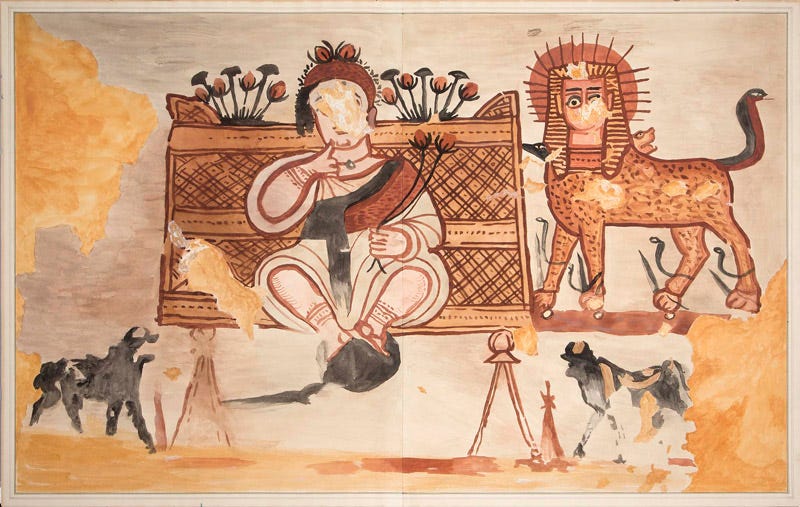
In early civilization, we find forms of nature worship at the forefront of religious development, with their highest incarnations beginning and ending with the sun and its stellar colleagues. Whoever the early inhabitants of the Nile Valley truly were, they were undoubtedly skilled in mathematics and astronomy and maintained a form of ‘sun worship’ that left room for a plethora of other gods and goddesses, each ruling over a distinct power in the heavens. But the most preeminent event in daily life was, of course, the dawn, worshiped under many names and not only by the Egyptians.
To the Greeks and Romans, the dawn was Eos or Aurora, siblings with the sun and moon and a member of the second class of Titans, -
"And Theia was subject in love to Hyperion and bare great Helios and clear Selene (Moon) and Eos (Dawn) who shine upon all that are on earth and upon the deathless Gods who live in the wide heaven." - Hesiod, Theogony (C8th - C7th BCE)
"Hyperion's daughter [Eos] expels the stars." - Ovid, Fasti (C1st BCE - C1st CE)
Far earlier than the Greek Titans were other Proto-European sky gods, who Max Muller, the prolific German orientalist, emphasizes in his studies of the sacred Hindu texts. -
2“I look upon the sunrise and sunset, on the daily return of day and night, on the battle between light and darkness, on the whole solar drama in all its details, that is acted every day, every month, every year, in heaven and in earth, as the principal subject.”
Considering the Egyptians spent thousands of years developing their various phases of sun worship, it moved beyond the designation of one or two gods and recognized, at different times of the day, different features of the same presence.
Harpocrates, Horus, or Khepri, in this case, represent the rising sun, whereas Ra is the sun at high noon, and Atum or Osiris the elder is the god at sunset. It is also pointed out by writers like J. Norman Lockyer that the title of the god changes depending on the respective season, becoming either Amen-Ra, Sebak-Ra, or Chnemu-Ra, etc. In his book The Dawn of Astronomy, the English astronomer documents a number of Egyptian hymns to the sun gods taken from their monuments -
“O Horus of the horizon, there is none other beside thee, Protector of millions, deliverer of tens of thousands.” - Hymn to Horus
“O Ra! in thine egg, radiant in thy disk, shining forth from the horizon, swimming over the steel firmament. Tmu and Horus of the horizon pay homage to thee in all their words.” - Hymn to Ra
“O Osiris! Thous art the youth at the horizon of heaven daily, and thine old age at the begining of all seasons. The ever-moving stars are under obediance to him, and so are the stars which set.” - Hymn to Osiris
In Egypt, rather than by way of a chariot, the gods are ever depicted as traveling by boat, over waters, across the firmament. We find depictions of the sky goddess Nut curiously underneath a barrier of stars with two types of water on either side of it, reminding us of a potential Egyptian source for Genesis 1:6 - 8.
“And God said, Let there be a firmament in the midst of the waters, and let it divide the waters from the waters. And God made the firmament, and divided the waters which were under the firmament from the waters which were above the firmament: and it was so. And God called the firmament Heaven. And the evening and the morning were the second day.”
When the light was no more, the gods of darkness reigned over Egypt, and Osiris performed his nightly combat with Set (Typhon) in the Egyptian underworld or Duat. When the god of light was victorious, he arose the following morning, providing quite plainly the earliest narrative for the immortality of the soul.
Beyond the symbolic function of the Egyptian deities and their relationship to the placement of the sun and stars, we are further compelled to notice the astrotheology in the layout of their temples. Whether the building plans correspond to the sun’s rising at the equinoxes, like the Pyramids at Giza, Memphis, Tanis, Sais, and Bubastis, or they correspond to the sun rising or setting at the solstices like the temples at Karnak, we can find plenty of examples to lend weight to equinoctial and solsticial building plans.
However, to mark an equinox or solstice wouldn’t have required the level of astronomical knowledge that, say, lining up the three Pyramids of Giza to the constellation of Orion’s Belt would have. Alas, we will leave the theory of the Orion correlation to a later time. To conclude this general overview, let’s gloss over a few more examples around the world of monuments aligned to one or another solar event.

Additional Solsticial Alignments.
It is now a non-controversial fact that Stonehenge is aligned with the rising sun on the summer solstice, just as the Pyramid of Chichen Itza in Mexico, and the so-called Aztec Ruins National Monument of New Mexico, or the solsticial alignments of the Temple of the Sun at Machu Pichu in Peru, the Mnajdra Temple in Malta, and the Newgrange monument in Ireland.
All around the world the ancients were aligning their monuments with solsticial and equinoctial dates, requiring a level of patience, attention, and precision that requires us to reconsider how they interpreted their spiritual place in the cosmos. To say nothing at the moment about how some of these megalithic stones were cut, moved, and positioned, we are still left with the fact that the earliest calendars were immortalized in stone and left behind as marvels for the modern world.
In the final introductory article, we will explore the definitions of the ancient gods of various civilizations, and review some of our Greek sources to interpret whether or not these gods were once human beings, once planets and stars, or had always been omniscient powers in nature and psychology, that were later personified and superimposed on the heavens.
Herodotus, The History, George Rawlinson, trans., (New York: Dutton & Co., 1862)Scanned by: J. S. Arkenberg, Dept. of History, Cal. State Fullerton. Prof. Arkenberg has modernized the text.
Lockyer, The Dawn of Astronomy, Dover Edition (p.23)