
The Solar Religion
Sun-worship & Similarities

Did ancient humans live in the same psychological realities that we do today?
Can we agree that it’s contrary to all evidence to assume that Ancient Man was merely a stupid creature? That he or she was a member of our shared world, who looked like us and lived like us but was incapable of building marvels or discovering spiritual truths that western science has ignored, or failed to recognize?
When someone claims an irrefutable fact, we hopefully test the merits of their evidence. But when evidence runs contrary to a problem in our working narrative that we thought was solved, there is resistance. Apply this same resistance to the dominant narratives of History & Religion, and it takes only a few places to look to throw it all into question.
Merely the discovery that modern humans are hybrids, or share our genome with that of the Denisovan, Neanderthal, and Cromagnon, for instance, made me step back and reflect on the Out of Africa theory, which I discovered was now being challenged by multiple studies.
Once again I am left with the question: is it time to rethink our story?
The answer for me is an obvious yes because our approach to history has failed to shift with new evidence. Are there too many publications to keep up with? Do established narratives become corporatized and rigid due to academe’s would-be monopoly on History?
There are broad categories to the mysteries we’re probing at that are cause for new questions. I list a few examples here, regardless of how pragmatic or fantastic their explanations have been in the past. It won’t be obvious how or if they are connected, but the breadth of this mystery forces us to take a second look more than twice.
It is not contreversial to claim that information already exists which could bring about a new interpretation of the past.
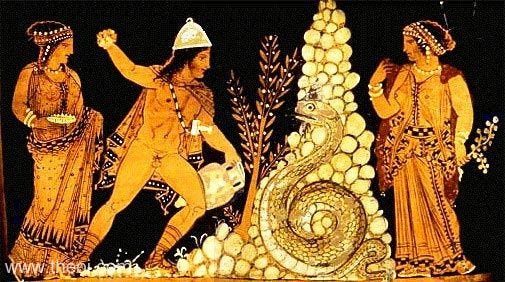
Outstanding similarities in rituals, symbols, myths, and spiritual conviction.
Serpent Worship, Phallic Worship, Fertility Goddesses, Flood Myths, Civilizing Heroes (Oannes, Dagon, Quetzalcoatl, Kukulkan, Osiris), Swastika Symbolism, Universal Astrology & Solstitial, and Equinoctial Alignments, Reincarnation, Creation Myths, Megalithic Building, Sun Gods, Magic and on and on ad nauseam.
The existence of similar beliefs and practices among distant civilizations should not be discounted as purely unconsiousness phenomena. There are certainly migrational and syncretic explanations, but not all of them have solved the essential mysteries of how, when, and why. As we will see, often there are no valid explanations, and it’s past time to admit it.
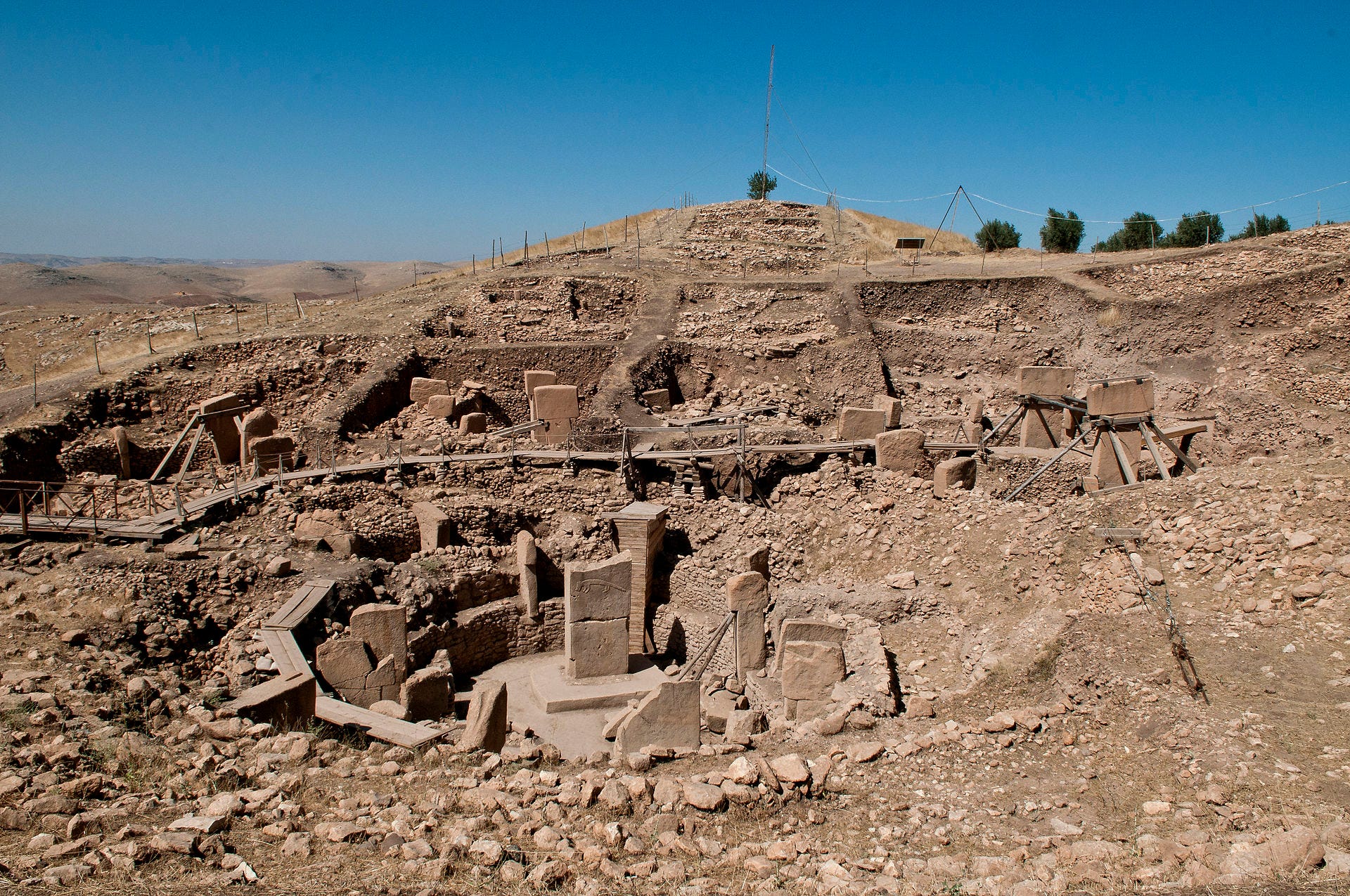
Outstanding Megalithic Sites
Turkey: Göbekli Tepe, Karahan Tepe
Egyptian Pyramids: Khufu, Snefru, Khafre, Menkaure etc.
The Sphinx & the Serapeum of Saqqara
The Americas: Chichen Itza, the Pyramid of the Moon, Uxmal, Tikal, Olmec Heads, Chaco Canyon.
England: Stonehenge, Orkney, Callanish, Castlerigg, etc.
Ireland: Newgrange
France: The Carnac Stones
Spain: The dolmens
Lebanon: Baalbek
Malta: Ggantija
Costa Rica: The stone spheres
Peru: Quenuani, Machu Picchu
Pacific: Easter Island
To understand any of these categories at a level of mastery might require lifetimes if it were possible at all. To disentangle their sources of evidence without being duped by the myriad of speculation around them also requires definite willpower. We want to avoid the tendency to over-analyze and create meaning where it serves no purpose.
The truth is more attracted to the curious than to those who reason from conclusion.
There is a presumption in traditional religions that the most important spiritual concepts have already been sorted out, leaving us little more to contribute but to pass on their true doctrines. It should not be this way in science, and it should not be this way with religion.
If I can be overly general for a moment, the average Christian has no idea about the tense disagreements that early Christians contended with inside their own churches. Just like the average fan of history can’t be expected to know the nuances of dating an archeological site, or discovering how the site was constructed.
That said, we should not inherently discount emerging historical mysteries or ancient religious dogmas simply on account of their divergence from popular opinion, or our personal incapacity to regurgitate the jargon related to its study. When broken down to their basic philosophies, most religions sing lyrics in the same choir. What if it were the same with their gods and their megalithic sites? What if we haven’t connected it all?
Where do the notes harmonize, and where do they segment?
There is always a god-infant in the bathwater we needn’t throw out with the tub.
Lacking the advantage and necessity for scientific reasoning, ancient humans had to rely on more internal resources to discover the secrets of nature. Then came the ones who told the stories, and in the practice of identifying similarities between natural processes in the world, and the internal life of the individual, human intelligence and the archetypal qualities of nature were innately fused, giving us the sequences of gods and mythologic dramas.
The most glaring example of an object that separate religions have rallied around is, of course, the sun. Sun worship charts back to as early as the spiritual inclination, and if using the term “sun worship,” is considered too imprecise, it will suffice to point out that the earliest civilizations incorporated the reverence of the solar orb into their religious customs, even if they did not devote their entire practice to it.
Everything from the date of particular rituals, to the roles of various deities, relied on the position and import of the sun. But just like no one can trace the origins of religion no one knows when the first humans attached a religious value to the sun. It isn’t hard for us to imagine that they would. There is never a time we do not depend on it, and thus the sun held a special place in nearly every pantheon.
And God said, ‘Let there be lights in the vault of the sky to separate the day from the night, and let them serve as signs to mark sacred times, and days and years.’ - Genesis 1:14
Order and sequence were established as much by the Sun as human intelligence was under its influence. Mathematics and Astronomy were among the first sciences to exist, going hand-in-hand with the qualities of nature, and thus enriching our view of the world. We use words like enlighten and illuminate to describe acquiring knowledge. Light bulbs turn on in our heads, we clear things up when there is a misunderstanding, and shed light on ideas. Light is already a spectrum of electromagnetic frequencies almost entirely inaccessible to the eye. Just like sound is to the ears, and emotion to the body. Thinking about the Sun’s practical existence leaves us with many spiritual inferences, and we shouldn’t consider it arcane to compare God or gods to the star that completes our mortal prerequisites.
The Sun provides us with all light and life, a beacon to all directions from a single source. It is the first witnessed spherical object, the celestial body bound to the Phoenician-Greek Hercules and his twelve labors through the Zodiac, the All-Seeing Eye on my Masonic degrees and textbooks, and the object of universal veneration.
As Freemasons should know, the symbolism of Hiram Abiff, the builder of King Solomon’s Temple, is intimately related to the course of the sun. In fact, Freemasonry emphasizes the three stages of the sun which manifest in various trinities around the world, namely: Dawn, High Noon, and Sunset. Or to the Egyptians, the gods Khepri, Re, and Atum.
Our planet and our religions revolve around the redeemer that rises victorious from the east. The light of immortality that survives the darkness. There is no denying or hiding its power. There is no way to affect it, making the Sun one of the greatest possible symbols of God.
“It may be that there's nothing in the visible realm which is more beautiful or less erratic then these decorations in the sky, but even so, since they're within the visible realm, they should be regarded as considerably inferior to true decorations, … We should use the heavenly decorations merely as illustrations to help us study the other realm.” - Plato (Republic)
Humans around the world see the same light but call it by different names, and make up different stories about how it got there and what it does. Sometimes we curse it for scorching us and other times we yearn when it’s absent. Our earliest and most serious architectural monuments are connected to the heavens through various geometric methods. But before we demonstrate the architectural features of early astrotheology, let’s look at some incarnations of solar deities, starting with the Egyptian god Re, who inhabited a seat with the highest of the Egyptian gods from the earliest stage.
Solar Egypt
Typical of Ancient Egyptian deities, Re (Ra) took on many syncretized monikers during the thousands of years of his development. Eventually being depicted as Re-Harakhty, and falcon-headed through his association with Horus. Re, in some mythological narratives (see the work of E. A. Wallis Budge), was a primary creator god, and the father of the eight other gods of Egypt. Re is considered the father of Maat, and therefore is the very source of truth and justice.
Depending on the province that Egyptian worshippers lived in, their gods and theologies would have been distinct to their locality. Thus wherever you studied or worshiped would affect the actual timeline and origin stories of your pantheon. In Thebes, for instance, during the 11th dynasty (c. 1980 BCE) we find Amon, the king of the gods, merging with Re in Amon-Re. In his own right, Re is essential to the eventual Osirian takeover and may be one of the greatest and oldest gods of Egypt. When Re was first manifested out of the Darkness and the Primeval Ocean, he arose out of an island and created Shu, representing dryness and air, and Tefnut, representing humidity. These “gods” generated the earth god, Geb, and the sky goddess, Nut. In turn, Geb and Nut gave birth to Osiris, the Lord of the World.
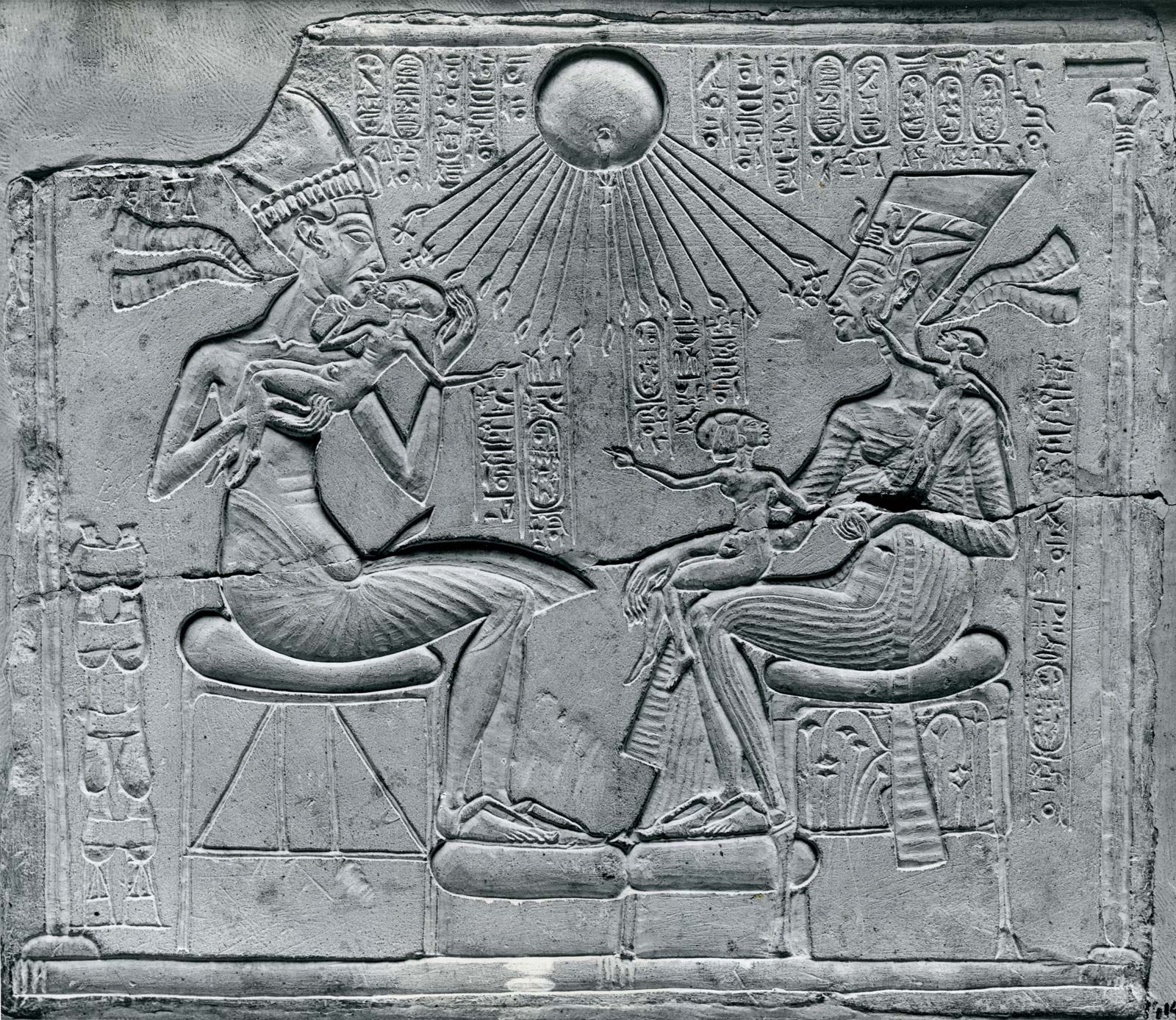
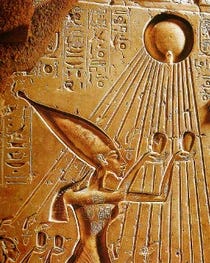
Not only were the deified pharaohs of Egypt made into mortal sun gods, but other sun gods like Amon emerged to rival Re’s influence. But no solar tradition in Egypt strikes the note that Pharaoh Akhenaton did during his seventeen years as Pharaoh beginning around 1353 BCE. Akhenaton is credited with the creation of the so-called first monotheistic religion of Egypt, Atensim, which revolved around the sun god, Aten, depicted as a solar disk emitting rays of light. With the worship of Aten, the old traditions that required a plentitude of gods were threatened by a single pharaoh’s urge to syncretize them into a single Being.
Solar Mesopotamia
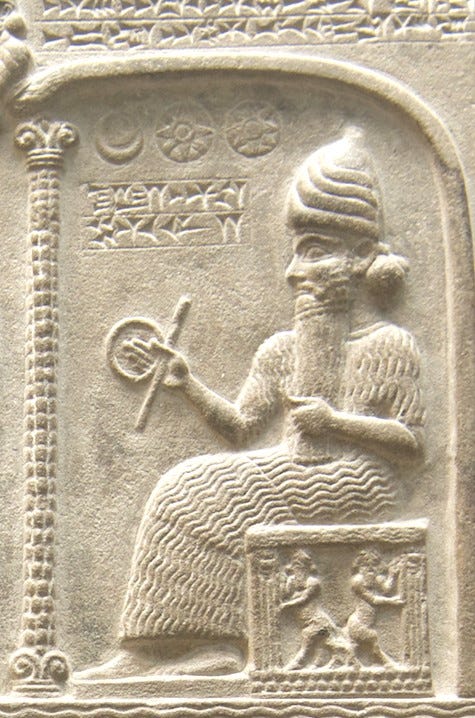
In Mesopotamia, dating back to at least 3,500 BCE, the god Utu rode through the heavens on a chariot much like the Greek god, Helios, and was associated with an all-seeing power and therefore enforced justice and morality. He is depicted on a cylinder seal found at Sipper with rays emitting from his shoulders, dating back to 2300 BCE. And later on, Utu took on the name Shamash among the Akkadians and Caananites. Utu is shown bearded with a rod-and-ring, and he was called “long armed” due to the extensive reach of his power.
Solar Persia
Ascribed to the teachings of the fire-prophet Zarathustra (Zoroaster), Zoroastrianism — or Mazdeism as re-influenced by Zoroaster — is among the oldest spiritual traditions known to date. Being the pre-Islamic religion of Persia it ranks among the more influential religions of the ancient world, and a number of its sacred writings still survive.
The date and life of Zoroaster are wholly uncertain, and it reflects the notions of Greek authors to state that he was not a contemporary of the many sages living in the 6th century BCE, but was of far greater antiquity. Irani in his translation of the Gathas gives 1300 BCE, whereas writers like Pliny the Elder, Plutarch, etc. claim he anti-dated the Trojan War by five thousand years. Max Muller, the great German Orientalist who translated the Zoroastrian Zend-Avesta, points out in his introduction, that :
“When he lived no one knows, and everyone agrees that all that the Parsis and Greeks tell of him is mere legend through which no solid historical facts can be arrived at. The question is whether Zoroaster was a man converted into a god, or a god converted into a man.”
These conflicting opinions reflect the challenges of the external history relating to Zoroaster and we can’t join the ranks of the dating argument here, but pinpoint the solar qualities of the tradition.
This brings us to Mithra, a Persian god of the sun who oversaw many other aspects of natural and social life, like the seasons and contracts. Mithra was probably more ancient than Zoroastrianism itself, and the Zoroastrians continued to revere him, beginning somewhere around the 7th century BCE.
Similarly, as Re occupies an ancient place in the Egyptian Pantheon we see much the same for Mithra in his earlier phase as an Indo-European deity prior to the 3rd Millennia BCE.
Mithra is described in the Avesta as so:
“He who first, of the heavenly gods, reaches over the Hara [Alburz Mountains], before the undying, swift-horsed sun; who, foremost in a golden array, takes hold of the beautiful summits, and from thence looks over the abode of the Aryans [Iranian peoples] with a beneficent eye. (Yasht 10.13, as cited in Curtis, 14)
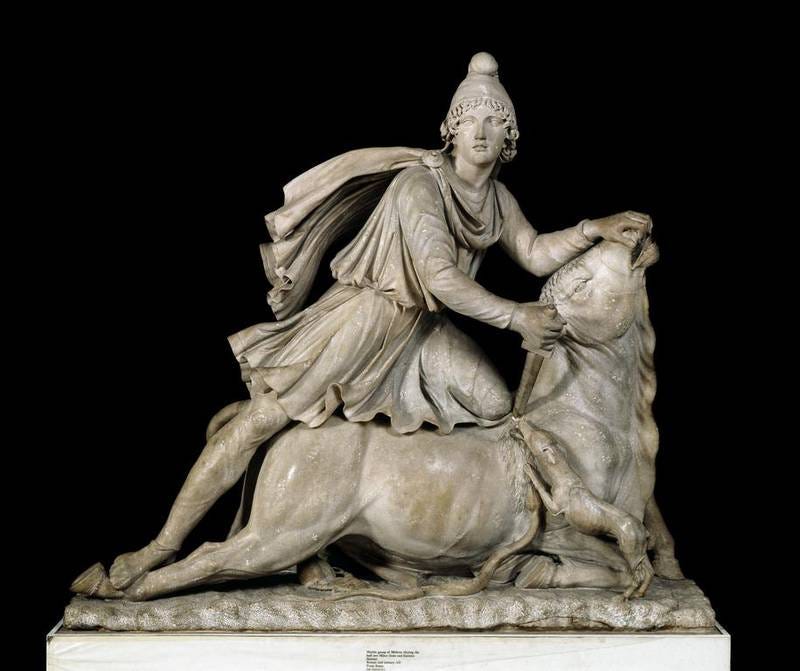
In the Hymn to Mithra, the god is described as “the lord of wide pastures, with ten thousand ears and ten thousand eyes,” again another solar equation to an all-seeing power. And as we find in Plutarch’s writings on the matter, Mithras was the mediator between the Persian gods, Ahura Mazda, and his evil counterpart, Ahriman. He is depicted almost entirely as a young man slaying the celestial bull (Taurus?), which we find extensively represented by the Romans, who were so taken away at some point with this Persian god, that they established the sophisticated Mithraic Mysteries in his name, and the Roman army worshipped the diety from at least the 1st century CE to the 4th century CE.
Mithra slaying the bull appears to have been a new element to Mithra’s story invented by this new cult, who performed sacred rites in a chamber that Porphyry says was an image of the cosmos. Thus Mithra in the case of slaying the bull would be the sun in the constellation Taurus, during the so-called Age of Taurus between the 5th and 3rd Millenia BCE, as explained by David Ulansey, author of The Origins of the Mithraic Mysteries (Oxford University Press, 1991) -
“For the constellations pictured in the standard tauroctony have one thing in common: namely, they all lay on the celestial equator as it was positioned during the epoch immediately preceeding the Greco-Roman "Age of Aries." During that earlier age, which we may call the "Age of Taurus," lasting from around 4,000 to 2,000 B.C., the celestial equator passed through Taurus the Bull (the spring equinox of that epoch), Canis Minor the Dog, Hydra the Snake, Corvus the Raven, and Scorpio the Scorpion (the autumn equinox): that is, precisely the constellations represented in the Mithraic tauroctony.”